Komodo Dragon vs Crocodile: Reptile Rulers
Two living dinosaurs, two apex predators, two very different hunting strategies. The Komodo dragon — the world's largest lizard — and the saltwater crocodile — the world's largest reptile — represent millions of years of reptilian evolution. Here's how these prehistoric predators compare.
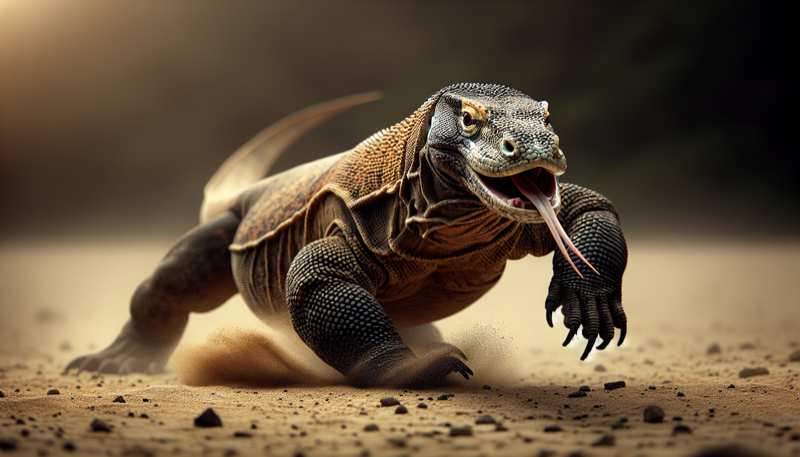
Quick Stats
Head-to-Head Comparison
Size & Strength
Saltwater crocodiles are enormously larger — males reach 5-7 metres and 1,000 kg, compared to the Komodo dragon's 2.5-3 metres and 70-90 kg. The saltie has the strongest bite force of any living animal at 3,700 PSI. The Komodo has a relatively weak bite (500 PSI) but compensates with venom and bacteria.
Speed & Agility
Komodo dragons can sprint at 20 km/h on land and are decent swimmers. Saltwater crocodiles are fast in water (24-29 km/h) and explosive from a standstill, but slow on land. On land, the Komodo is more mobile; in water, the croc is untouchable.
Hunting Ability
Crocodiles are ambush masters with the death roll — an instantly lethal drowning technique. Komodo dragons use a unique strategy: a venomous bite that causes rapid blood loss and shock, then they patiently follow the weakened prey for hours or even days until it collapses. Both are terrifyingly effective.
Intelligence
Komodo dragons are surprisingly intelligent for reptiles — they use play behaviour, recognise individual keepers, and employ cooperative hunting strategies. Crocodiles are also smart, using tools (sticks to lure birds) and coordinated hunting. Both exceed typical reptile intelligence expectations.
Where to See Them
Komodo dragons are found only on a few Indonesian islands — Komodo National Park is the primary destination, accessible by boat from Flores. Saltwater crocodiles are widespread across Southeast Asia and Northern Australia — Kakadu National Park and the Adelaide River in Australia offer the best sightings.
Conservation Status
Komodo dragons are Endangered with approximately 3,000 remaining in the wild, confined to a tiny range. Saltwater crocodiles are Least Concern with healthy populations across their range, having recovered well from historical hunting. The Komodo dragon's restricted habitat makes it far more vulnerable.
Fun Fact
Komodo dragons reproduce through parthenogenesis — females can lay viable eggs without mating. This was first confirmed in 2006 at London Zoo when a captive female who had never been housed with a male produced fertile eggs. It's thought to be a survival mechanism for these island-dwelling reptiles.
Our Verdict
Komodo National Park is a bucket-list destination accessible via day trips or liveaboard boats from Labuan Bajo, Flores. Rangers guide you to see dragons up close in their natural habitat. For saltwater crocodiles, Northern Australia's Kakadu National Park and the Adelaide River jumping croc cruises are spectacular. Pair a Komodo visit with Bali for an incredible Indonesia wildlife itinerary.