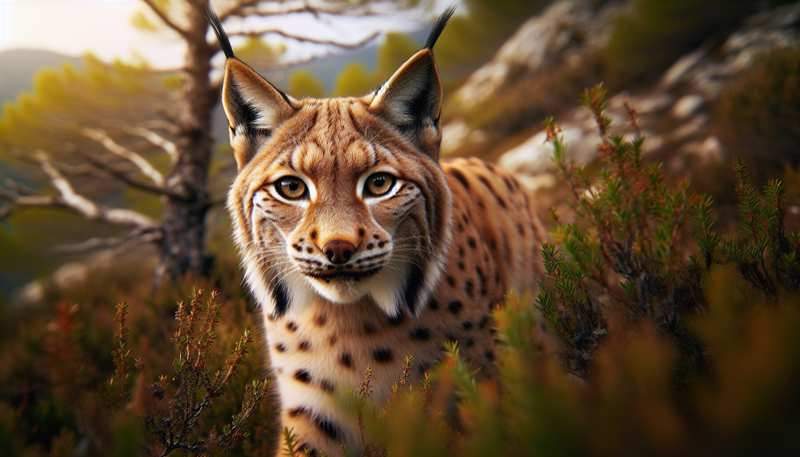
The Iberian lynx lives only in Spain and Portugal, but a range map is not a visitor map. Some populations occupy private land, active recovery areas, or habitat where sharing precise locations could increase disturbance. A responsible trip starts with public protected landscapes, official access information, and enough time to enjoy the whole Mediterranean ecosystem whether or not a lynx appears.
This guide compares three practical public regions: Sierra de Andújar and Doñana in Spain, and the Guadiana Valley in Portugal. It explains what each offers, when to plan, how guided and independent viewing differ, and which location details should stay private. For the species' biology, habitat, and current status, open our Iberian lynx guide.
Where does the Iberian lynx live?
The Iberian lynx is endemic to the Iberian Peninsula. Its modern recovery has involved habitat management, rabbit recovery, road-risk reduction, captive breeding, reintroduction, monitoring, and cooperation between public authorities and conservation partners in Spain and Portugal. The joint Spain–Portugal conservation strategy describes a distribution that is expanding beyond the species' last strongholds.
That recovery is important context, not a reason to expect an easy sighting. Lynx occur at low density, spend time inside cover, and do not follow a tour timetable. New reintroduction areas are conservation projects before they are tourism products. Do not travel to a release point, den, or live monitoring location unless the managing authority has expressly created a public visitor activity there.
The IUCN moved the species from Endangered to Vulnerable in its 2024 global assessment. Its Iberian lynx recovery assessment presents this as the result of sustained conservation action while identifying habitat, prey, disease, road mortality, and other threats that still require work. “Vulnerable” does not mean common, secure everywhere, or safe from disturbance.
Sierra de Andújar, Spain
Sierra de Andújar Natural Park in Andalucía is the best-established public base for a lynx-focused visitor. Its Mediterranean hills, scrub, dehesa, river valleys, rabbits, deer, raptors, and other carnivores make a rewarding wildlife trip even when the target cat remains hidden. The official Viñas de Peñallana visitor-centre information explains the park landscape and its importance for the lynx population.
Public roads, official visitor infrastructure, legal viewpoints, and properly managed hides are the relevant visitor spaces. Some land is private, and the presence of other observers does not turn a verge, gate, track, or estate into public access. Check Andalucía's current visitor portal for notices and ask the park information centre about closures or route conditions before each visit.
Who Sierra de Andújar suits
- Travellers happy to spend long, quiet sessions scanning habitat.
- People who want a specialist local guide or hide option but understand that neither guarantees a lynx.
- Wildlife watchers interested in the broader Mediterranean community, not a single photograph.
- Visitors able to keep to public access and tolerate cool mornings, changing weather, and limited facilities away from town.
Use our Spain wildlife guide to place Andújar within a wider national trip. One base and several observation sessions normally make more sense than racing between distant lynx regions after an online sighting report.
Doñana, Spain
Doñana protects a mosaic of marsh, dunes, scrub, woodland, and transition habitat in southwest Spain. It is globally known for wetlands and birds and also holds Iberian lynx. For visitors, it is a large protected system with different zones, access types, visitor centres, boardwalks, observatories, and guided itineraries—not an open landscape where every track can be explored.
The park's official visitor rules and recommendations tell visitors to use established trails, respect silence, follow staff instructions, and reserve limited-capacity guided itineraries in advance. They also recommend binoculars and warn against false expectations. That is especially relevant to a lynx trip: Doñana is a place to understand a complete protected landscape, not a sighting guarantee.
Who Doñana suits
- Travellers whose main goal is a diverse wetland and Mediterranean wildlife experience.
- Birders who would value the trip without seeing a lynx.
- Visitors looking for official centres, accessible boardwalks, observatories, or a managed guided route.
- People combining nature with a broader Andalucía itinerary rather than devoting every day to distant scanning.
Do not assume that a captive or interpreted lynx exhibit represents the probability of a wild encounter. If an official visitor programme includes an interpretation facility, understand whether the animals are captive before describing or photographing the experience as wild.
Guadiana Valley, Portugal
Portugal's modern wild population was re-established in the Guadiana Valley around Mértola. The national conservation authority's official reintroduction overview explains why the landscape was selected, including habitat, prey, threat, and local-participation considerations. It also makes the conservation point that breeding animals in captivity is not enough without suitable wild habitat.
The public visitor proposition is the valley landscape: walking routes, birding, Mediterranean fauna, local culture, and interpretation around a recovering predator. It is not access to release enclosures, capture work, collars, or live telemetry. Use the ICNF protected-area information, local visitor services, and legal public routes around Mértola; treat any lynx sighting as an exceptional outcome rather than something a guide must produce.
Who the Guadiana Valley suits
- Travellers interested in reintroduction, habitat, and community context.
- Independent nature visitors willing to build around public routes and wider wildlife.
- People who prefer a slower rural Portugal itinerary to a dedicated sighting chase.
- Visitors prepared to check heat, fire restrictions, route access, and opening information close to travel.
Start with our Portugal wildlife guide and the Europe wildlife hub if you are comparing this trip with wolves, bears, whales, seabirds, or Arctic wildlife elsewhere in the region.
When is the best time to look?
Cooler months are often chosen because observers can spend longer in exposed viewpoints and animals may be active across more comfortable parts of the day. Some trips focus on winter, but a calendar claim should not override current access, weather, fire risk, breeding sensitivity, or local guidance. Lynx movement and visibility vary between individuals and days.
Plan around the experience you can control:
- Field time: allow several sessions instead of a single rushed stop.
- Light: prepare for low-angle morning or evening light without assuming those are the only possible activity windows.
- Weather: carry quiet layers and rain protection appropriate to the region; avoid noisy fabrics around a hide.
- Day length: shorter days reduce total scanning time but can make a focused schedule more comfortable.
- Breeding sensitivity: never interpret increased seasonal activity as permission to search for dens or follow an animal.
Check the managing authority and chosen guide shortly before travel. Wildfire conditions, storms, road works, conservation operations, or temporary closures can change a route after an article is reviewed.
Guided tour, hide, or self-guided viewing?
Local guide
A good local naturalist helps with legal access, habitat interpretation, scanning technique, other wildlife, language, and current park information. Ask whether the guide uses public routes or has written permission for private land; how group size is capped; what happens when an animal approaches a road; and whether the guide withholds sensitive location data.
Avoid anyone who advertises access to a den, promises a specific cat, uses live collar data for clients, drives off legal routes, baits with rabbits or scent, or encourages several vehicles to leapfrog an animal.
Managed hide
A hide can reduce visible human movement, but the word itself proves little. Ask who owns the land, whether construction and access are permitted, how people enter and leave without displacing wildlife, whether food or scent is used, how toilet and waste needs are managed, and what happens if a lynx settles nearby after the advertised session.
Choose enough space, an honest no-sighting policy, and a guide who will prevent noise and lens movement through openings. A hide should manage people, not manipulate the cat.
Independent viewing
Independent watching can work from legal public places when you already have strong field skills and current access information. It does not mean following tour vehicles, copying a pin from a private group, parking dangerously, or entering land through an unlocked gate. Visit the official centre first, ask where public observation is permitted, and make the habitat—not another person's lens direction—the basis of your search.
Fieldcraft for seeing a lynx responsibly
- Scan slowly. Work from open ground and edges into gaps in the scrub; repeat the same area rather than constantly moving.
- Use binoculars first. Confirm an animal before swinging a large lens or alerting a group.
- Keep voices and movement low. Silence also improves the experience of other observers.
- Watch the whole scene. Rabbits, deer, magpies, raptors, and other species make the waiting worthwhile and can teach you how the habitat functions.
- Never pursue. If a lynx crosses a road or disappears into cover, let it go. Do not drive ahead repeatedly to force another view.
- Leave space. Do not create a crowd at a narrow verge, gate, or entrance, and never block residents, emergency access, or wildlife movement.
Our forest and woodland wildlife guide provides more habitat-led discovery. The ethical wildlife tourism guide has a reusable test for guides, hides, protected areas, sanctuaries, and conservation claims.
Photography and sensitive location rules
Bring a lens long enough to frame the animal without approaching, but do not let focal length become a reason to monopolise the best opening. Avoid playback, calls, bait, drones, flash, and artificial light unless a managing authority has a specific, lawful protocol for a different purpose. Follow local rules even when another photographer ignores them.
Before posting, remove precise coordinates and clues that reveal a den, dependent young, a release site, a road crossing, private access, or a newly occupied territory. Delay a general public-location post if real-time attention could create a crowd. A responsible caption can name Sierra de Andújar, Doñana, or the Guadiana Valley without identifying the exact point.
Do not state that a photograph is wild if it was made at a fenced interpretation or breeding facility. Captive conservation has played an important role in recovery, but transparent labelling protects trust in both the image and the project.
How your trip can support recovery
Spend with local guides, accommodation, restaurants, and nature businesses that value living lynx habitat and follow access rules. Ask guides how they participate in community monitoring, road-safety awareness, habitat work, or responsible visitor education, but do not demand private conservation data as proof.
For direct support, our Iberian lynx conservation programme review explains a Portugal-based education and habitat programme and routes readers to the organisation's official page. Read the mechanism carefully: learning, donating, membership, and symbolic products are different actions, and a general payment may not be restricted to one species unless the checkout says so.
Final planning checklist
- Choose a public visitor region, not a sensitive population pin.
- Check the official park or conservation authority for current access and notices.
- Allow repeated sessions and plan a trip that succeeds without a lynx sighting.
- Verify a guide's permissions, group size, no-sighting policy, and location-sharing standards.
- Ask how a hide operates and confirm that it does not bait or displace wildlife.
- Use long optics, stay on legal access, and never follow an animal.
- Remove sensitive detail before sharing images or trip reports.
- Keep local spending and conservation support transparent.
The Iberian lynx recovery is a reason for careful optimism. The best visitor response is patience: give the cat space, give the landscape time, and make sure the trip still rewards the communities and habitats that made recovery possible.